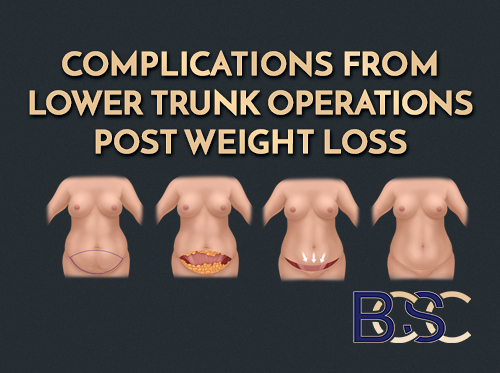
Complications from Lower Trunk Operations Post Weight Loss
Lower torso and lower trunk procedures are a central part of body contouring surgery after major weight loss. Operations may include abdominoplasty (commonly known as
Read more
Lower torso and lower trunk procedures are a central part of body contouring surgery after major weight loss. Operations may include abdominoplasty (commonly known as
Read more
15/10/2024
Substantial weight loss could leave excess skin and fat 360 degrees around your waist, affecting your abdomen, flanks, upper pubic zone, buttocks, and thighs. Belt lipectomy surgery removes excess skin from these areas with a 360-degree incision around the belt line. This surgical procedure is often performed in one or two stages and is one of the most comprehensive options for post-weight-loss patients after losing more than 30 kilos. Preparing for a Belt Lipectomy Before your body contouring surgery, you’ll meet with the surgeon for a consultation. Your surgeon will review the following: Who is a Candidate for a Belt
Read more10/10/2024
Losing 30+ kilos often leaves behind loose skin and stubborn fat deposits on the abdomen and nearby areas such as the lower back, hips, thighs, pubic area, and buttocks. Tightening loose skin in all these areas is achievable through belt lipectomy surgery, also known as a lower body lift. Though the surgical scar is quite long, many patients find the tradeoff is worth it for a firmer-looking physique. What is a Belt Lipectomy (Circumferential Body Lift)? Belt lipectomy surgery removes excess skin and fat 360 degrees around the waist after a patient has undergone significant weight loss. It features a
Read more25/09/2024
Self-assessment measures, such as evaluating physical condition, defining Fleur-de-lis (FDL) goals, assessing skin laxity extent, and determining discomfort or dysfunction can help a patient determine if they are the ideal FDL candidates. More extensive and complex than standard abdominoplasty, Fleur-de-lis (FDL) abdominoplasty is the ideal option for anyone with skin laxity on the abdominal area that cannot be effectively treated with a traditional tummy tuck (Abdominoplasty) procedure. However, it can be challenging for patients to determine whether they are ideal candidates for an FDL procedure on their own, which is why I highly suggest that you come in for a
Read more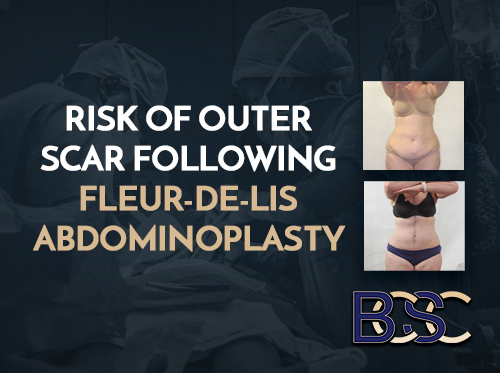
22/09/2024
Most individuals undergo Fleur-de-Lis abdominoplasty to target their abdominal contour. However, one should not overlook the risks associated with the procedure and all other surgical procedures. One such risk is scarring after Fleur-de-Lis abdominoplasty. It’s important to note that you cannot avoid scars in totality after a surgical procedure. There are ways, however, to make them less conspicuous and reduce the risk of abnormal scarring. The patient also has a role to play. Therefore, learning about scarring following Fleur-de-Lis Abdominoplasty, how to reduce the risk, and what treatment options are available are crucial. If this seems too complicated and challenging,
Read more20/09/2023
Like any surgical procedure, an abdominoplasty (commonly called a tummy tuck) leaves a scar. The scar is typically a horizontal line across the lower abdomen. For many patients, one consideration is how the scar may sit in relation to their clothing and swimwear. At the Body Contouring Surgery Clinic (BCSC), our surgeons discuss scar placement with each patient during the consultation. The aim is to find a position that balances surgical requirements with a patient’s usual clothing choices. Types of Abdominoplasty Scars Different techniques are used depending on how much excess skin and tissue need to be removed. Each leaves
Read more