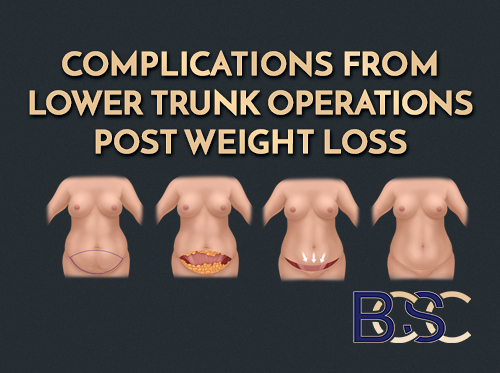
Complications from Lower Trunk Operations Post Weight Loss

18/10/2025

Complications from Lower Trunk Operations Post Weight Loss

Complications from Lower Trunk Operations Post Weight Loss Lower torso and lower trunk procedures are a central part of body contouring surgery after major weight loss. Operations may include abdominoplasty (commonly known as tummy tuck), extended abdominoplasty, Fleur-de-Lis abdominoplasty, and circumferential lipectomy (also known as a lower body lift or belt lipectomy). For many post bariatric patients, these operations are carried out to remove excess skin and redundant skin that remains after significant or massive weight loss. This article provides an overview of potential complications from lower trunk operations post weight loss. Understanding possible surgical complications helps patients prepare for

Read more
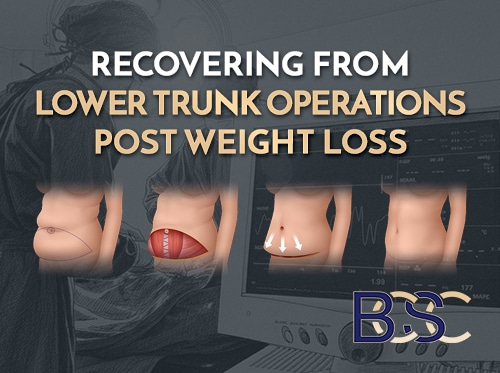
Recovering from Lower Trunk Operations Post Weight Loss

16/10/2025

Recovering from Lower Trunk Operations Post Weight Loss

Recovering from Lower Trunk Operations Post Weight Loss Recovering from lower trunk operations post weight loss is a significant stage in the journey of massive weight loss patients. Many individuals who have experienced significant weight loss – whether through bariatric surgery (weight loss surgery), lifestyle changes, or medically supervised weight-loss medications – find themselves with excess skin and fat that does not retract on its own. This excess skin can lead to rashes, hygiene difficulties, mobility issues, and reduced quality of life due to physical limitations. At Body Contouring Surgery Clinic (BCSC), our team of specialist surgeons performs body contouring

Read more
Different Types of Abdominoplasty Surgery for Your Unique Body Concern Post Weight Loss

28/01/2025

Different Types of Abdominoplasty Surgery for Your Unique Body Concern Post Weight Loss

Different Types of Abdominoplasty Surgery for Your Unique Body Concern Post Weight Loss Abdominoplasty is a surgical procedure designed to target multiple concerns resulting from significant weight loss after bariatric surgery or pregnancy.  Because each patient is unique, abdominoplasty can be tailored to suit the concerns, needs, and goals, as well as the medical history of each patient. Examples If, for example, a post-pregnancy patient presents with muscle separation (diastasis recti) and excess fat but minimal loose skin laterally, a full abdominoplasty with diastasis recti repair and VASER Liposuction would be the likely course of treatment. On the other hand,

Read more

16/11/2024

Traditional Abdominoplasty vs. Fleur-de-lis Abdominoplasty

Traditional Abdominoplasty vs. Fleur-de-lis Abdominoplasty Both the fleur-de-lis and traditional abdominoplasty procedures are designed to treat excess skin, and they share some significant similarities. However, there are key differences between them. The fleur-de-lis abdominoplasty is a more extensive abdominoplasty procedure that treats loose skin both horizontally and vertically. In contrast, traditional abdominoplasty surgery primarily focuses on vertical loose skin only. Excess Horizontal skin | BCSC Patients considering abdominoplasty (tummy tuck) may have challenges choosing the right procedure that meets their goals. Both traditional abdominoplasty and fleur-de-lis abdominoplasty treat excess abdominal skin and fatty tissue. They share numerous similarities but still

Read more
Treating Loose Skin Following Bariatric Surgery on the Abdomen and Back

25/04/2024

Treating Loose Skin Following Bariatric Surgery on the Abdomen and Back

Treating Loose Skin Following Bariatric Surgery on the Abdomen and Back Treating loose skin on the abdomen and back following bariatric surgery involves non-invasive approaches like maintaining a balanced diet, exercising, and topical treatments; or surgical procedures like an abdominoplasty. Abdominal and back skin can lead to health and psychological complications. Therefore, most post-bariatric patients will seek ways to get rid of the excessive loose skin on their back and abdomen. Treating  loose skin resulting from bariatric surgery involves non-surgical or surgical approaches. Tattoo (on right arm) blurred for privacy Disclaimer: Operation performed by Dr Bernard Beldholm. Adult content, surgery

Read more
Fleur-de-Lis Abdominoplasty Surgery Guide

20/04/2024

Fleur-de-Lis Abdominoplasty Surgery Guide

Fleur-de-Lis Abdominoplasty Surgery Guide Fleur-de-Lis is an abdominoplasty procedure involving a vertical and a horizontal incision intersecting at the groin region, forming an inverted T. The procedure helps remove loose skin in patients with major weight loss, which would be challenging to remove through standard abdominoplasty procedures. This fleur de lis surgery guide helps elaborate further on Fleur-de-Lis abdominoplasty, the surgery process, recovery, pros and cons, suitability, and how to prepare for the procedure.  Disclaimer: Operation performed by Dr Bernard Beldholm. Adult content, surgery has risks; individual results vary, seek 2nd opinion. Please see the full disclaimer. What is Fleur-de-Lis Abdominoplasty?

Read more
Revision Abdominoplasty (Tummy Tuck) Surgery in Australia

14/04/2024

Revision Abdominoplasty Surgery in Australia

Revision Abdominoplasty Surgery in Australia For patients who feel dissatisfied or experience complications, revision surgery is a potential remedy. Just like the initial abdominoplasty surgery, revision abdominoplasty, also known as secondary abdominoplasty, involves removing excess abdominal skin and repairing separated abdominal muscles. The main aim of revision abdominoplasty (tummy tuck) is to correct complications resulting from the primary procedure. However, revision abdominoplasty can be challenging, posing additional risks than the primary procedure. Therefore, patients should be aware of the process, potential risks, and recovery before considering revision abdominoplasty.  What is Revision Abdominoplasty Surgery? Revision abdominoplasty is a follow-up abdominoplasty procedure

Read more
Role of Nutrition and Exercise Post-Abdominoplasty (Tummy Tuck)

10/04/2024

Role of Nutrition and Exercise Post-Abdominoplasty

Role of Nutrition and Exercise Post-Abdominoplasty  The period following surgery is crucial for proper healing, maintaining surgical results, and overall health. Nutrition and exercise are vital components of this recovery process after abdominoplasty (tummy tuck) as they support tissue healing, prevent complications, aid recovery, and promote long-term well-being. This article explores the importance of nutrition and exercise in post-abdominoplasty care, offering advice and tips to help individuals effectively navigate their recovery and achieve lasting benefits. Pre-Operative Role of Exercise and Nutrition Before Abdominoplasty Surgery Before getting abdominoplasty surgery, it is essential to concentrate on exercise and a proper tummy tuck

Read more
What is Fleur-de-Lis Abdominoplasty?

06/04/2024

What is Fleur-de-Lis Abdominoplasty?

What is Fleur-de-Lis Abdominoplasty? Traditional abdominoplasty may be inadequate in the treatment of the abdominal contours in major weight loss patients. This requires a specialised abdominoplasty procedure that adequately target this challenge. Fleur-de-Lis is an abdominoplasty technique that removes significant redundant belly skin and fat vertically and horizontally in major weight loss patients.  If you have had massive weight loss resulting in redundant excess abdominal skin in the upper belly as well as the lower abdominal wall, you may be a candidate for a Fleur-de-Lis abdominoplasty. But what exactly is Fleur-de-Lis abdominoplasty? This guide looks at the technique, how it

Read more
How to Maintain Results Following Abdominoplasty

01/04/2024

How to Maintain Results Following Abdominoplasty

How to Maintain Results Following Abdominoplasty Maintaining the results of an abdominoplasty involves a combination of proper post-operative care, a healthy lifestyle, ongoing attention to an individual’s body, and a little patience.  Tips for Maintaining Abdominoplasty Results Maintaining the results of abdominoplasty involves combining proper post-operative care, lifestyle adjustments, and ongoing health habits. Some notable areas of concern include:   Tip#1: Following All Post-Operative Instructions Patients should adhere to their surgeon’s post-operative instructions to achieve a successful recovery and obtain the best possible results. These instructions may include caring for wounds, following medication schedules, avoiding alcohol and smoking, limiting activities, and

Read more